ESG Research Process
We believe industry-specific transition is necessary in order to meet the global goals for climate, nature and sustainable development. Targets and goals that can be adequately measured and managed allow us to monitor performance and change over time. We take reference from scientific bodies, such as IPCC and IPBES, and the Global Goals set within the Paris Agreement, the Global Biodiversity Framework and the SDGs.
ESG Assessment Process – Sustainalytics Indicators
To support our ESG integration framework approach, we engage Sustainalytics as an ESG data provider, whose methodology aligns with our ESG Research Framework.
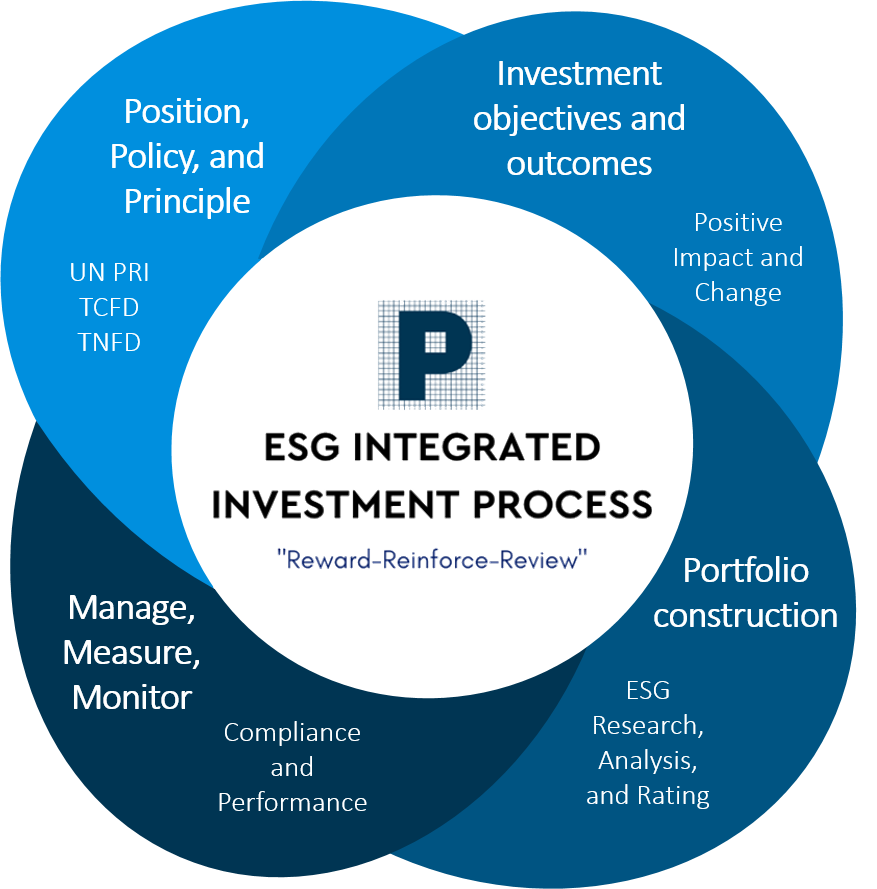
We customise the use of Sustainalytics data by using up to 26 indicators from Sustainalytics to assess each investee company in our portfolio of investments. The 26 indicators are purposefully chosen to align to our three (3) research objectives:
- Objective 1 – Managing ESG risk.
- Objective 2 – Mitigating negative externalities.
- Objective 3 – Measuring positive change and impact.
This customised assessment is performed on a monthly basis for Sustainable Reserve Fund and on a quarterly basis for all other funds that we manage. This assessment is also conducted on a new underlying investment in the Sustainable Reserve Fund.
For a satisfactory overall ESG rating, we internally assign either “low risk” or “medium risk” rating to an issuer. For clarity, we deem that an issuer has an unsatisfactory overall ESG rating when it is rated as “high risk”.
Below are the 26 indicators along with the descriptions:
| No. |
Indicator Name |
Description of Indicator |
| 1 |
Environmental Policy |
This indicator assesses a company’s commitment to manage its operations with a view to prevent, reduce or mitigate any harmful effects on the environment and natural resources. |
| 2 |
GHG Reduction Programme |
This indicator assesses the strength of a company’s programme and associated initiatives to manage and reduce GHG emissions associated with its operational boundary. |
| 3 |
Board Independence |
This indicator assesses the percentage of independent directors on the board, as defined by Sustainalytics’ in-house criteria for judging director independence. |
| 4 |
Board Gender Diversity |
This indicator assesses directors gender representation within the board to verify whether there is gender balance. The assessment evaluates gender identities across male, female and non-binary. |
| 5 |
Board Gender Representation Target |
This indicator assesses the strength of a company’s target to ensure board gender equality. |
| 6 |
Global Compact Signatory |
This indicator identifies whether a company is a member of the internationally recognized United Nations Global Compact (UN Global Compact). This demonstrates a company’s commitment to aligning its strategies and operations with universal principles on human rights, labour, the environment and anti-corruption, and to taking actions that advance societal goals. |
| 7 |
ESG Governance |
This indicator provides an assessment of whether a company has assigned board or executive level responsibility for oversight of ESG issues. The indicator tracks whether there are specific management committees in charge of managing ESG issues across the group. |
| 8 |
Risk Oversight |
This indicator assesses a company risk management system, with an emphasis on the board role in the supervision of the risk management framework. |
| 9 |
GHG Performance Incentive Plan |
This indicator assesses a company’s remuneration process with a focus on programmes that link greenhouse gas (GHG) emissions reductions or wider climate-related targets to remuneration. |
| 10 |
ESG Reporting Standards |
This indicator assesses a company’s environmental, social and governance (ESG) disclosures and the extent to which the reporting adheres to best practice guidelines or globally recognized sustainability reporting standards. |
| 11 |
Verification of ESG Reporting |
This indicator assesses a company’s disclosure of whether its ESG reporting has been externally verified in accordance with a recognized assurance standard. Both the scope of verification and the level of assurance for the report are assessed. |
| 12 |
Scope of GHG Reporting |
This indicator assesses the greenhouse gas (GHG) emissions associated with a company’s business activities, including both direct (scope 1) and indirect (scope 2 and 3) emissions. |
| 13 |
GHG Reduction Programme |
This indicator assesses the strength of a company’s programme and associated initiatives to manage and reduce GHG emissions associated with its operational boundary. |
| 14 |
GHG Emissions Targets |
This indicator assesses the strength of a company’s greenhouse gas (GHG) emissions reduction targets. |
| 15 |
GHG Emissions Target Progress |
This indicator assesses whether a company is on track to meet its stated greenhouse gas (GHG) reduction targets. |
| 16 |
Discrimination Policy |
This indicator assesses a company’s commitment to prohibit workplace discrimination and ensure equal opportunity, and it is aligned with the International Labour Organization’s (ILO) related conventions. |
| 17 |
Diversity Programmes |
This indicator assesses a company’s initiatives to strengthen workplace diversity and develop a more inclusive workforce, including having managerial or board level oversight, targets, training and guidance. |
| 18 |
Human Capital Development |
This indicator assesses a company’s initiatives to recruit, retain and develop human capital to manage risks associated with skilled labour shortages or labour relations issues, including, talent development and retention initiatives and detailed reporting on risks relating to human capital management. |
| 19 |
Freedom of Association Policy |
This indicator assesses a company’s commitment to ensure that its employees have the right to associate and collectively bargain. Collective bargaining, a negotiation process between employers and employees aimed that aims to form agreements to regulate working salaries, conditions and benefits, should be permitted. |
| 20 |
Business Ethics Programme |
This indicator assesses a company’s initiatives to ensure that business ethics are promoted and adhered to. The indicator focuses especially on the process and implementation of its internal code of conduct, particularly on ethical issues. |
| 21 |
Whistleblower Programmes |
This indicator assesses the quality and scope of a company’s mechanisms for reporting illegal or unethical actions, including disclosure of the number of reports received, actions taken and investigation mechanisms. |
| 22 |
Bribery & Corruption Policy |
This indicator assesses a company’s commitment to reduce or eliminate instances of bribery and corruption across its business activities (including its own operations and its supply chain). A bribe includes any illegal payment from one party to another while corruption includes the abuse of entrusted power for private gain. |
| 23 |
Bribery & Corruption Programmes |
This indicator assesses a company’s programmes to eliminate or reduce instances of bribery and corruption across its business activities (including its own operations and its supply chain). |
| 24 |
ESG Governance |
This indicator provides an assessment of whether a company has assigned board or executive level responsibility for oversight of ESG issues. The indicator tracks whether there are specific management committees in charge of managing ESG issues across the group. |
| 25 |
Scope of Social Supplier Standards |
This indicator assesses a company’s commitment to prevent violations of human rights across its suppliers’ operations. Such violations or social issues include: workers’ health and safety, minimum living wages and maximum working hours, freedom of association and the right to collective bargaining, child and forced labour, acceptable living conditions, non-discrimination, and disciplinary practices. |
| 26 |
Supplier Environmental Policy |
This indicator assesses a company’s commitment to purchase goods and services that have a reduced environmental impact throughout their life cycle, compared to alternatives (that serve the same purpose) that would normally be purchased. |
ESG Assessment Process – Proprietary ESG Research
Under specific conditions, we will conduct ESG risk assessment on an investee company using our proprietary ESG research. The research reports produced by our proprietary ESG research are internally referred to “ESG Rapid Reports”. This research is based on three (3) research objectives mentioned above.
Each research objective includes Environmental, Social, and Governance metrics financially material to the industry and where relevant, specific to the assessed investee company. Each research objective assesses risks and opportunities across domains that address, amongst others, social injustice, health, climate change, biodiversity loss, and pollution.
We use our proprietary ESG research to assess an investee company if any of the following conditions is met:
- The investee company is a new underlying investment in the Sustainable Reserve Fund that has scored an unsatisfactory overall ESG rating based on the assessment result from the evaluation of Sustainalytics indicators described above.
- The investee company is one of the top ten (10) largest holdings in the Sustainable Reserve Fund, irrespective of its overall ESG rating based on assessment result from the evaluation of Sustainalytics indicators described above.
- The investee company is one of the issuers named in the high carbon intensity or high nature impact watch list. This watch list is guided by Climate Action 100+ and Nature Action 100. Climate Action 100+ is a global, investor-led initiative that engages 169 companies globally to drive stronger climate governance, reduce greenhouse gas emissions, and improve climate-related disclosures and transition plans. Nature Action 100 is a global, investor-led initiative that engages 100 large companies across eight key sectors that are systemically important for nature and ecosystem services.
The issuance of the ESG Rapid Reports is prioritised based on the above order of 1 to 3.
The primary sources of ESG information used for the ESG Rapid Reports are:
- Sustainability reports and annual financial reports issued by the company.
- Information, such as company policies, made publicly available by the company.
- Controversial news on the company, published by credible and reputable news organisations.
Based on information we extract from the above sources, we use a scoring system of at least 35 metrics and these metrics are relevant to each of the three research objectives. The metrics assess, amongst other things, the level of action taken by the issuer, the issuer’s contribution/transition to the green economy, and the issuer’s commitment to its own targets and to global goals. Some of the metrics are associated with the Sustainability Accounting Standards Board (SASB), Task Force on Climate-Related Financial Disclosures (TCFD) and UN-supported Principles for Responsible Investment (PRI).
Each metric is scored on a scale of 1 to 10. For objectives 1 and 2, scoring focuses on the quality of disclosures and strength of commitments. For objective 3, scoring focuses on measurable, time-bound targets with a clear implementation trajectory.
The overall ESG rating of the investee company, whether satisfactory or unsatisfactory, is determined by the weighted average score of the assessed metrics. This overall ESG rating derived from our proprietary ESG research will supersede the overall ESG rating, if any, derived from the assessment of the Sustainalytics indicators.
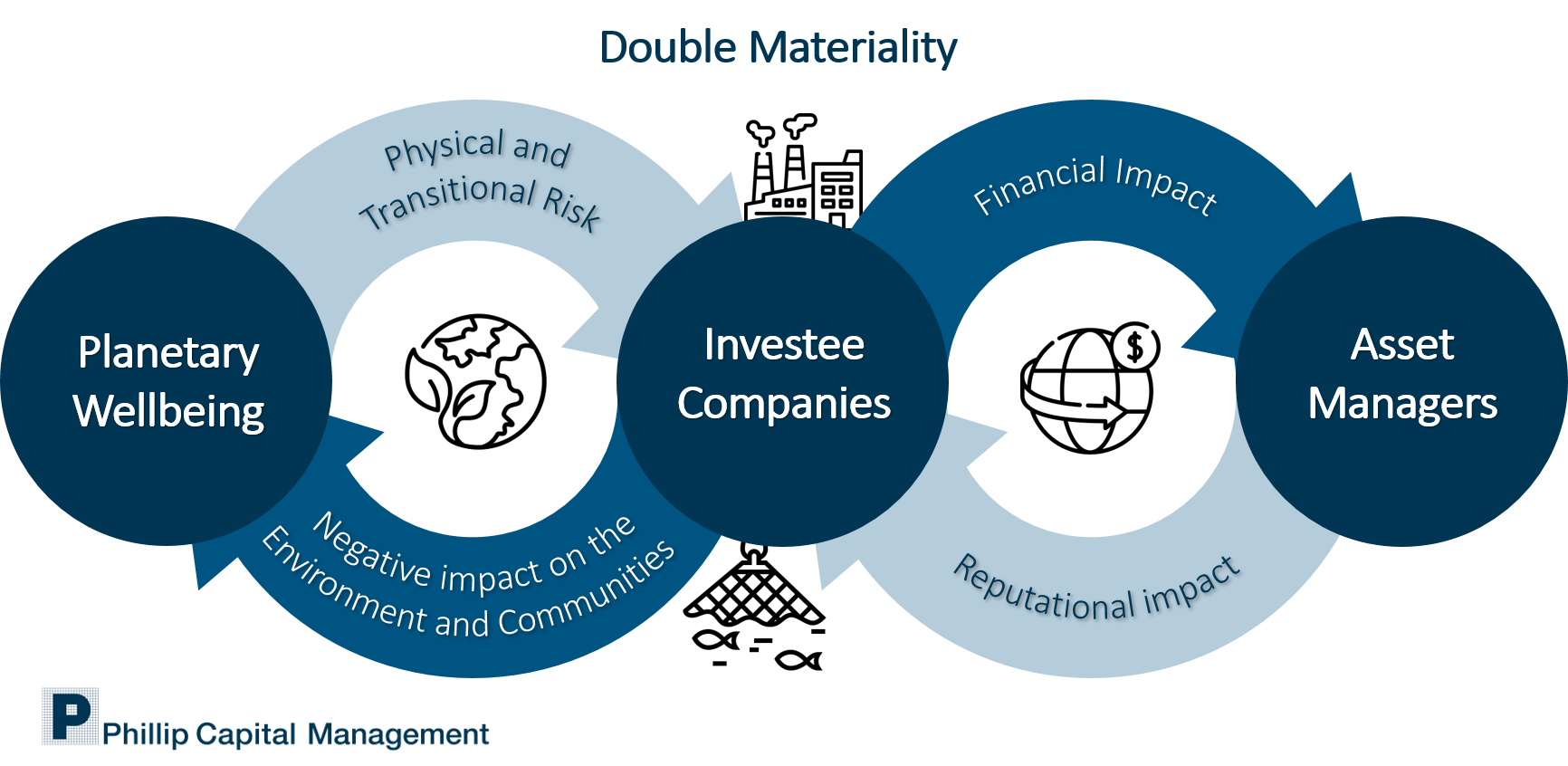
In the Sustainalytics ESG assessment, the 26 indicators reflect what is measured in the rapid report metrics. The ESG Rapid Reports’ 35 metrics are categorised into 9 groupings and these groupings can be matched to the Sustainalytics indicators chosen. The aforesaid reinforces the shared objective of assessing double materiality.
For the purpose of paragraph 8 of Circular No. CFC 02/2022 Disclosure and Reporting Guidelines for Retail ESG Funds (“ESG Circular”) issued by the Monetary Authority of Singapore, at least two-thirds of the net asset value of the Sustainable Reserve Fund must be invested in companies we deem to have satisfactory overall ESG rating.
Important Information:
Please refer to the respective product prospectus for specific details before making any investment decision.
This advertisement or publication has not been reviewed by the Monetary Authority of Singapore.