
Who Pays for Climate Change? From Nepal’s Floods to Singapore’s Plates
- Countries that contribute the least to global warming, from Nepal to Southeast Asia’s fishing communities, absorb some of its sharpest losses, while the finance meant to cover those losses falls far short.
- These losses do not stay local. Even a wealthy, well-prepared economy is exposed, and the cost will balloon without stronger global cooperation. Companies are both contributors to and exposed to this risk.
The world is about to cross a line it once promised not to. In September, the UN Environment Programme reported that global temperatures will likely exceed 1.5°C within the next few years, with the best-case scenario peaking at 1.8°C and most others above 2°C. Current government policies still point to around 2.8°C of warming by 2100. Small island states and low-lying coastal cities face the risk of partial or complete submersion, and adaptation becomes harder and more expensive the longer warming persists. This is the planetary boundary for climate change being pushed further, and those least responsible for it are the least cushioned against it.
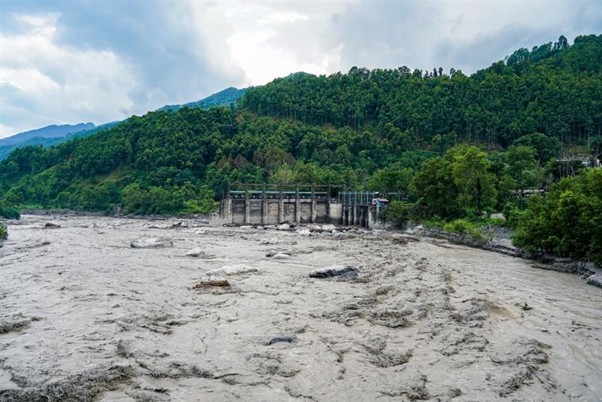
Fig.1: Bhotekoshi-Trishuli floods
Nepal shows what this looks like. Prime Minister Balendra Shah told the UN that Nepal contributes less than 0.1% of global greenhouse gas emissions yet repeatedly suffers climate disasters. The Bhotekoshi-Trishuli floods killed at least 1,400 people, left over 6,000 missing and caused damage equivalent to about 10% of GDP. On IMF estimates of a US$46 billion economy, that is roughly US$4.6 billion. Nepal’s exposure is not confined to one event. Persistent late-monsoon rain between 24 and 28 September set off about 285 recorded landslides and killed at least 15 people, with flood warnings issued for 49 of the country’s 77 districts. Mr. Shah called existing climate finance, including the Loss and Damage Fund, “grossly inadequate”, and the fund’s design and size explain why.
The Fund for responding to Loss and Damage is meant to pay for harm that adaptation can no longer prevent. It is hosted by the World Bank and depends on voluntary pledges from developed countries rather than a fixed contribution. Pledges total about US$789 million against developing-country needs of roughly US$400 billion a year, around 0.2% of one year’s need. Its first round holds just US$250 million for 2025–2026, with grants of US$5–20 million each, and countries must apply within set submission windows. Critics also note that this start-up phase has no mechanism for rapid payouts after a disaster. A single event the size of Nepal’s floods is therefore about eighteen times the entire first round, and money that arrives in tens of millions cannot rebuild an economy that lost billions.
The damage compounds because vulnerable countries also pay more to recover. Research on the V20 group of climate-vulnerable economies found that climate vulnerability is associated with a cost of debt about 1.17% higher, equal to an estimated US$62 billion in additional interest for 40 V20 members between 2007 and 2016. Higher borrowing costs leave less room for flood defences and disaster relief, so the next shock costs more. This is not only their problem. These economies supply food and other goods to the rest of the world, and a weaker capacity to recover means less reliable supply for the buyers who depend on them.
Fisheries show how this plays out on the ground. As waters warm, fish move to deeper waters, so fishers travel farther and burn more fuel for each catch, while extreme heat shortens the working day. In Eastern Samar in the Philippines, fishers who once left at 6am and worked until 3pm now often return by 10am, roughly four hours at sea instead of nine, or more than half their fishing time lost. A daily catch that once earned around P1,500 (US$24) is now smaller and costs more to reach. These communities had little buffer to begin with: the fishing sector’s poverty rate is 30.6%, double the national rate of 15.1%. Lower income then spreads through the household. Families cut spending on transport and food, children in remote villages five kilometres from school miss classes when the catch cannot cover the fare, and there is less to fall back on when the next typhoon arrives.
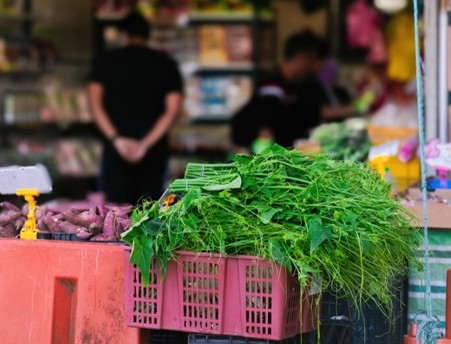
Fig.2: Food market
Even a wealthy, well-prepared country like Singapore is not spared. We import more than 90% of our food from over 180 countries and regions, and high incomes and diversified sourcing have historically helped cushion Singapore against global food price shocks. But a buffer is not immunity. Heavy rains in Southeast Asia in 2022 caused vegetable shortages here. When supply from farms like these is disrupted, the cost eventually reaches our import bill and our plates. At home, we are also paying to adapt: the government topped up the Coastal and Flood Protection Fund by S$5 billion in Budget 2025, with mean sea level around Singapore projected to rise by up to 1.15 metres by 2100.
These costs will not stay where they are if the world does not act together. UNEP’s Executive Director Inger Andersen has warned that climate impacts will “strike faster, hit harder, and last longer”, and every fraction of a degree above 1.5°C brings more severe impacts for supply chains, public budgets and households alike. Individual countries can adapt only so far. Without concerted global effort to cut emissions and to fund adaptation in the most vulnerable countries, the cost of higher food prices, sea defences and disrupted supply will keep growing for everyone, including those that emit least and those best prepared.
Companies play a considerable role on both sides of the climate challenge. On the one hand, they are significant contributors to global emissions, and without active corporate decarbonisation, climate goals and resilience cannot be achieved. Companies must also recognise that their emissions can increasingly be traced to specific environmental and social harms, bringing greater reputational and legal scrutiny. On the other hand, companies are also exposed to the physical and social impacts of climate change through their supply chains. For example, food and seafood companies sourcing from climate-exposed regions may face supply disruptions and cost volatility, alongside growing scrutiny of how their suppliers and workers are treated.
As investors, we assess this issue through our three research objectives. First, we look at whether companies understand and manage the climate risks in their value chains, including supplier concentration in climate-vulnerable regions. Second, we look at whether they mitigate their negative externalities on the communities and ecosystems they affect. Third, we look for contributions to climate resilience and adaptation, consistent with SDG 13.1 on strengthening resilience to climate-related hazards. We value companies that map their supply-chain exposure, engage and support suppliers in building resilience, and disclose credible transition plans. We reward those that treat affected communities fairly as part of doing business, recognising that resilience further down the chain protects long-term value further up it.
The Blueprint
With the ever-changing landscape around us, it can get overwhelming to stay up-to-date. The Blueprint highlights pertinent global Environmental, Social, and Governance (ESG) issues and their importance to investors and the wider community. We look forward to engaging in discussions about the interconnections between climate, nature, and social outcomes that impact our investments and our futures.
Important Information
This material is provided by Phillip Capital Management (S) Ltd (“Phillipfunds”) for general information only and does not constitute a recommendation, an offer to sell, or a solicitation of any offer to invest in any of the exchange-traded fund (“ETF”) or the unit trust (“Products”) mentioned herein. It does not have any regard to your specific investment objectives, financial situation and any of your particular needs.
The information provided herein may be obtained or compiled from public and/or third party sources that Phillipfunds has no reason to believe are unreliable. Any opinion or view herein is an expression of belief of the individual author or the indicated source (as applicable) only. Phillipfunds makes no representation or warranty that such information is accurate, complete, verified or should be relied upon as such. The information does not constitute, and should not be used as a substitute for tax, legal or investment advice.
The information herein are not for any person in any jurisdiction or country where such distribution or availability for use would contravene any applicable law or regulation or would subject Phillipfunds to any registration or licensing requirement in such jurisdiction or country. The Products is not offered to U.S. Persons. PhillipCapital Group of Companies, including Phillipfunds, their affiliates and/or their officers, directors and/or employees may own or have positions in the Products. This advertisement has not been reviewed by the Monetary Authority of Singapore.
