
Haze Without Borders
- A super El Niño, made more likely by a warming climate, is drying out Southeast Asia’s peatlands. The resulting fires are sending haze across borders and damaging health, schooling and livelihoods.
- The haze is also an economic risk. It threatens palm oil, a crop that now feeds both our food supply and Indonesia’s diesel, so a poor harvest can push up costs for consumers. How companies and governments respond tests their social and governance standards.
On 3 October, National Environment Agency (NEA) reported that smoke plumes from southern Sumatra were again pushing Singapore’s 24-hour PSI as high as 104, in the unhealthy range. It is the latest sign of a regional haze crisis driven by a super El Niño, which a warming climate is making more likely and which the World Meteorological Organisation (WMO) expects to persist through February 2027.
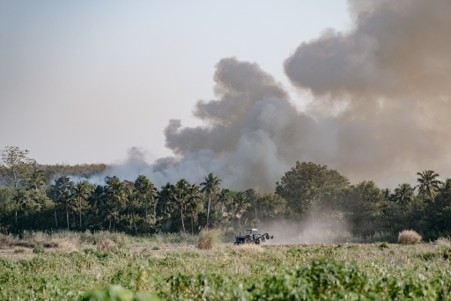
Fig.1: Burning Forest
El Niño is a periodic warming of the tropical Pacific, and during an event, the rain normally centred over Indonesia and the far western Pacific shifts eastward into the central Pacific, leaving parts of Indonesia in drought. It becomes a “super” El Niño when ocean temperatures run more than 2°C above normal, and on 14 September, NOAA data showed this year’s event had crossed that threshold. Climate change is making such events more likely: one study found that extreme El Niño events could occur twice as often under 1.5°C of warming. Because the world is already close to that level of warming, each El Niño now arrives on a hotter baseline.
Drought then turns that dryness into fire. Indonesia’s forests and peatlands are naturally too moist to ignite on their own, but nearly all fires in Indonesia are human-caused, typically set to clear land, and canals dug to drain peat swamps have lowered water tables, leaving the peat dry enough to burn. In a wet year, these fires stay contained. In a drought, they escape, and because peat burns below the surface and smoulders for weeks, it produces far more fine particulate matter than ordinary forest fires. That smoke is the haze. By the end of August, nearly 896,000 hectares had burned, and peat hotspots detected in the first eight months were more than double those recorded in the strong El Niño year of 2015.
The smoke does not stop at the border. It has reached Malaysia, Singapore, southern Thailand and the southern Philippines, and visibility at Pontianak airport in West Kalimantan fell to about 100 metres. In Malaysian Borneo, Kuching and nearby Serian recorded readings above 400 on the Air Pollutant Index, which, like Singapore’s PSI, rates anything above 100 as unhealthy. In late August, nearly 600 schools around Kuching closed, affecting about 200,000 students, and weekly asthma cases rose from 219 to 1,811, according to Malaysia’s Ministry of Health. The fires are in one country, but the damage lands in several, so no single government can contain it alone.
These costs fall on people who did not light the fires: children kept out of school, outdoor workers who lose income, and families dealing with respiratory illness. The World Bank estimated that the 2015 fires cost Indonesia US$16.1 billion, or 1.9% of GDP but accountability is hard to establish. At the regional level, the 2002 ASEAN haze agreement is binding but does not allow one member state to sue another, and Singapore’s 2014 law depends on foreign cooperation.
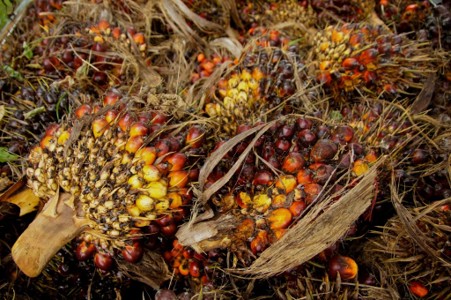
Fig.2: Harvested Palm Fruit
The same dry spell also threatens palm oil, which is where haze becomes an economic story. Palm trees respond to drought slowly, so the effect on supply shows up with a lag of 12 to 16 months. That points to lower output in 2027 and 2028. Some producers have already reported fresh fruit bunch production down 6% in the first half of 2026. Prices today do not yet reflect this. Malaysian crude palm oil (CPO) futures closed at RM4,533 per tonne in early October, a 12-week low, as stocks above 3 million tonnes and weak September exports weigh on the market. That is about 7.5% lower than a month ago and only 2% above a year earlier. In economic terms, a drought is a supply shock: when supply falls and demand stay the same, prices rise. Stocks are cushioning that shock for now, so we see the risk to prices as skewed upward once the lagged supply loss arrives.
Palm oil is also a food staple which supplies about 40% of the world’s vegetable oil and appears in roughly half of packaged grocery products, from frying oil and margarine to chocolate. Replacing it would take four to ten times more land, so a poor harvest can quickly reach grocery prices.
Biodiesel adds a second claim on the same crop. Indonesia has made B50 mandatory since 1 July 2026, meaning diesel must contain 50% palm-based biodiesel. The aim is to cut diesel imports and save about Rp170 trillion (US$9.55 billion) a year in foreign exchange. Malaysia currently requires B10, with B20 in some areas, and in April it announced a move to B15, starting with B12 after diesel prices more than doubled between February and early April. Oil prices also remain elevated after the Middle East conflict, with Brent averaging above $100 per barrel in September 2026. This is why governments are blending more palm oil into diesel. The side effect is that the cost of diesel is now tied to a crop that is vulnerable to drought. Analysts estimated that B50 needs about 3 million more tonnes of palm oil than B40, so mandated demand competes with food and export demand.
These pressures can feed through to the wider economy as cost-push inflation, where higher input costs lead businesses to raise prices. Diesel moves goods, including food, so higher fuel costs raise transport costs for almost everything. If these cost increases lead households and businesses to expect higher prices, they can also feed into wages and further price rises. For import-reliant economies like Singapore, which buys most of its fuel and food from abroad, higher regional fuel and commodity costs eventually reach consumers.
From the fire to the fuel pump to the supermarket shelf, each link depends on how well risks are managed. For companies, that covers the social side, such as how workers, smallholders and nearby communities are protected from harm and disruption, and the governance side, such as oversight of operations and suppliers and transparency about risks. For countries, it means enforcement and cooperation that reach those who cause the damage. Where management is weak, the costs show up in sick workers, disrupted supply and higher prices for businesses and households far from where the fire started.
As investors, we favour companies which actively plan and manage their climatic risks. This includes having a business continuity plan in anticipation of such climatic risks. For acute shocks such as a haze episode, flood or heatwave, it means backup suppliers and sites to ensure that a company can continue business as usual. For chronic stressors such as rising temperatures and water scarcity, companies should consider performing scenario analysis and location-specific risk mapping, to measure the value at risk and the share of operations in high water-risk locations. Above just financial materiality, it is also important for companies to consider how their operations effect the environment and the communities around them. We value companies that identify their double materiality early, disclose them transparently and plan for disruptions. We reward those that take responsibility for their impact of their own operations, because companies that manage risk in both directions are better placed to protect long-term value.
The Blueprint
With the ever-changing landscape around us, it can get overwhelming to stay up-to-date. The Blueprint highlights pertinent global Environmental, Social, and Governance (ESG) issues and their importance to investors and the wider community. We look forward to engaging in discussions about the interconnections between climate, nature, and social outcomes that impact our investments and our futures.
Important Information
This material is provided by Phillip Capital Management (S) Ltd (“Phillipfunds”) for general information only and does not constitute a recommendation, an offer to sell, or a solicitation of any offer to invest in any of the exchange-traded fund (“ETF”) or the unit trust (“Products”) mentioned herein. It does not have any regard to your specific investment objectives, financial situation and any of your particular needs.
The information provided herein may be obtained or compiled from public and/or third party sources that Phillipfunds has no reason to believe are unreliable. Any opinion or view herein is an expression of belief of the individual author or the indicated source (as applicable) only. Phillipfunds makes no representation or warranty that such information is accurate, complete, verified or should be relied upon as such. The information does not constitute, and should not be used as a substitute for tax, legal or investment advice.
The information herein are not for any person in any jurisdiction or country where such distribution or availability for use would contravene any applicable law or regulation or would subject Phillipfunds to any registration or licensing requirement in such jurisdiction or country. The Products is not offered to U.S. Persons. PhillipCapital Group of Companies, including Phillipfunds, their affiliates and/or their officers, directors and/or employees may own or have positions in the Products. This advertisement has not been reviewed by the Monetary Authority of Singapore.
